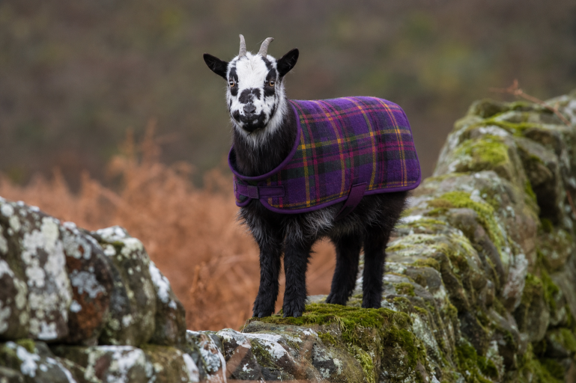
A new tartan created in the Scottish borderlands is paying homage to one of the nation's most misunderstood animals: the wild goats of the Langholm and Newcastleton Hills.
Developed by textile worker Julie Maxwell-Beatty, “The Wild Goats o' the Hills” tartan is far more than a pattern of colours and threads. It is a tribute to resilience, endurance and continuity. Above all, it is an acknowledgement that these wild goats form part of Scotland's living heritage.
For thousands of years, goats have been present within Britain and, for centuries, have roamed freely amongst Scotland's hills, glens, coastal cliffs and mountains. Yet despite their long association with the landscape, they are frequently dismissed as "feral" or categorised as an "alien" species by modern conservation frameworks.
Supporters of The Wild Goat Conservation Trust (TWGCT) believe such language fails to recognise a deeper truth.
Scotland's wild goats are not simply animals occupying a landscape; they are living links to the past, threads connecting the hill communities of yesterday with the Scotland of today.
Not all heritage is built of stone; some heritage breathes, and some heritage still walks the hills. Some heritage survives in the same rugged landscapes that shaped generations before us.
Mrs Maxwell-Beatty, who conceived the idea, said:
“I wanted to create a textile that reflected the wonderful colours of the wild hills where the goats roam free. The timing was everything; arguably the hills are at their most resplendent in late summer and early autumn, when the rut begins and the goats’ cycle of life is rekindled by their mating.”
“Purple heather blooms dominate the pattern, while bracken is represented in its glorious autumnal ochres. Subtle greens evoke bog mosses, and soft peaty tones of burnt umber run through the fabric. Lifted by scarlet threads representing the rowan berry, the design captures the colours of the hills in late summer and autumn.”
“With expert guidance from textile designers at Drove Weavers, Langholm, this has created a wonderfully rich and vibrant tartan of real heritage distinction, befitting the wild goats of our hills.”
The symbolism of the tartan itself is especially fitting. For centuries, tartan has represented identity, belonging and continuity. Through suppression, displacement, hardship and the upheavals of Scottish history, tartan and the communities associated with it endured.
The same might be said of this old herd of wild goats, which today finds itself in challenging times due to changes in land use.
David Braithwaite, Chairman of TWGCT, said:
"This tartan, in paying homage to these remarkable wild animals, also pays homage to endurance itself. The threads woven through the fabric reflect threads woven through our landscapes, our history and our collective identity. Scotland's clans endured. Their tartans endured. Our wild goats endured. Today, the goats continue to walk the hills as living reminders of a past that remains very much alive in the present. They are part of a living heritage that connects us with those who came before us and challenges us to think carefully about what we leave behind for those who have yet to come... for once broken, these threads may never be rewoven.”