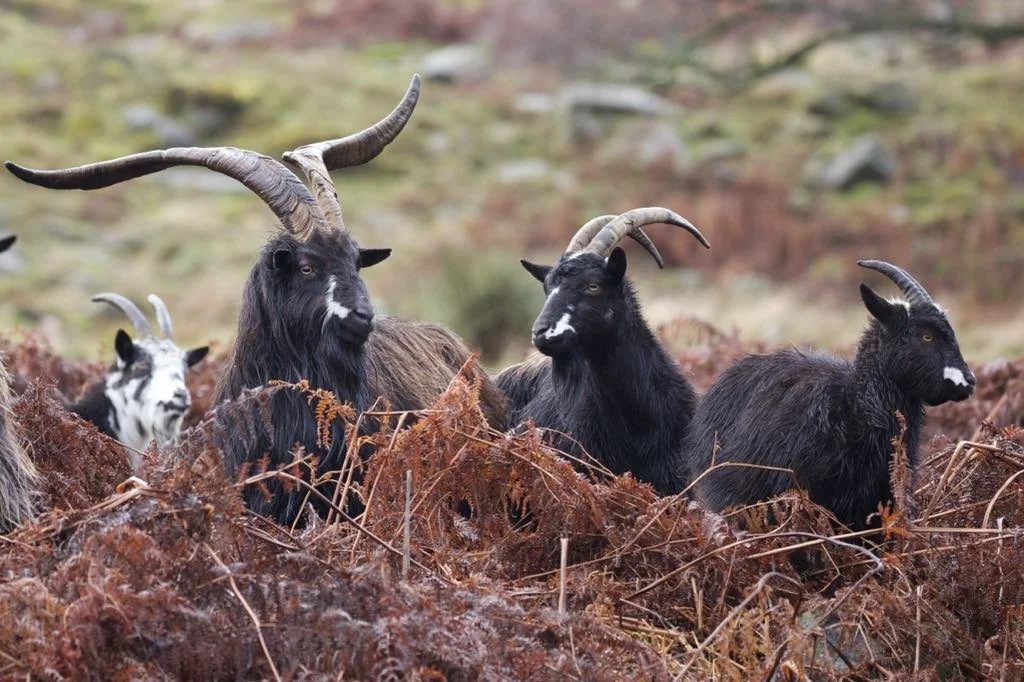
Photograph of Billie and Nannies courtesy of Nicola Hood
A recent comprehensive survey of the wild goats that roam the uplands between Langholm and Newcastleton has revealed a population dramatically smaller than previously believed, raising fresh questions about how one of Scotland's best-known wild goat herds is being managed.
The survey, commissioned by The Wild Goat Conservation Trust (TWGCT), involved ten experienced field ecologists covering more than 100 miles of survey routes and scanning approximately 50,000 acres of hill country. The final report recorded just 255 wild goats across the study area.
The findings challenge long-held assumptions about the size of the herd. In 2025, Tarras Valley Nature Reserve estimated between 800 and 900 animals. Combined with reports of 138 goats on Oxygen Conservation's Blackburn and Hartsgarth Estate and around 40 at Dinley Farm, total estimates ranged from 978 to 1,038 animals.
Those figures fuelled concerns that, following the sale of much of the former Buccleuch Estate hill ground, goat numbers were increasing unsustainably. Despite an outcry of local concern, significant culling subsequently took place during 2025.
However, Dr Shirley Goodyer, Scientific Adviser to TWGCT, believes the new survey paints a very different picture.
"Whilst we know that significant numbers of wild goats were culled by landowners last year (circa 200 declared), it is unlikely that this alone explains such a large discrepancy. As we have consistently argued, the herd should be managed through a coordinated plan based on robust scientific evidence. The current uncoordinated approach places the long-term future of the herd at risk. The population is clearly nothing like as strong as many had speculated."
The recent survey found that 94% of the goats were located within the designated Site of Special Scientific Interest (SSSI), with 84% of the entire population, 215 animals, recorded on the 10,500-acre Tarras Valley Nature Reserve managed by the Langholm Initiative. Whilst just 15 goats were observed on the 11,000-acre Blackburn and Hartsgarth Estate owned by Oxygen Conservation.
Dr Goodyer said the results highlighted the need for landowners and land managers to work together with conservationists.
"Without sensitive, coordinated management across neighbouring estates piecemeal culling jeopardises the whole population. Intensive control in one area risks displacing goats onto another. These animals have roamed these hills freely for centuries. Neither TWGCT nor the public, who have shown huge concern, want to see this end simply because land has changed hands."
The Langholm-Newcastleton herd attracted national attention in 2025 when a Scottish Parliamentary petition seeking protected status for the goats gathered more than 22,000 signatures. Although the petition was ultimately rejected, public interest in the future of Scotland's wild goats remains high.
David Braithwaite, Chairman of TWGCT, said:
"The narrative surrounding wild goats has too often been driven by assumptions rather than evidence. This survey provides the first reliable picture of the population and demonstrates that concerns about excessive goat numbers were misplaced. Equally important, it suggests that concerns about the vulnerability of this isolated herd are entirely justified. Scotland's wild goat herds deserve management decisions based on evidence, transparency and cooperation.
“We know that there is a lot of general interest in the conservation of this herd and we are planning to present the survey findings at open events for the local communities in the New Year. The details of the report will also be published on our website so that those further afield can see the results for themselves.”
The Trust fully intends to maintain the scientific work that it has started. Gail Brown, Vice Chair and Secretary of TWGCT, confirmed the commitment to continued monitoring.
"This is the first fully comprehensive survey of the herd. Previous figures were estimates, but we now have an important scientific baseline. We are deeply grateful to everyone who donated to make this work possible.
"In the New Year we will launch a volunteer ranger programme, training volunteers in hill safety and wildlife monitoring so that we can continue tracking the numbers and distribution of the herd for years to come."
TWGCT is also continuing its wider work on wild goat welfare across Scotland. The Trust currently supports a Scottish Parliamentary petition calling for a closed season on culling and hunting during the kidding season, together with safeguards governing major population reduction programmes.
Wild goats remain one of Scotland's few large mammal species without any specific statutory protection.